
Data study
We read 3,267car sales calls. Here’s how the best reps handle objections.
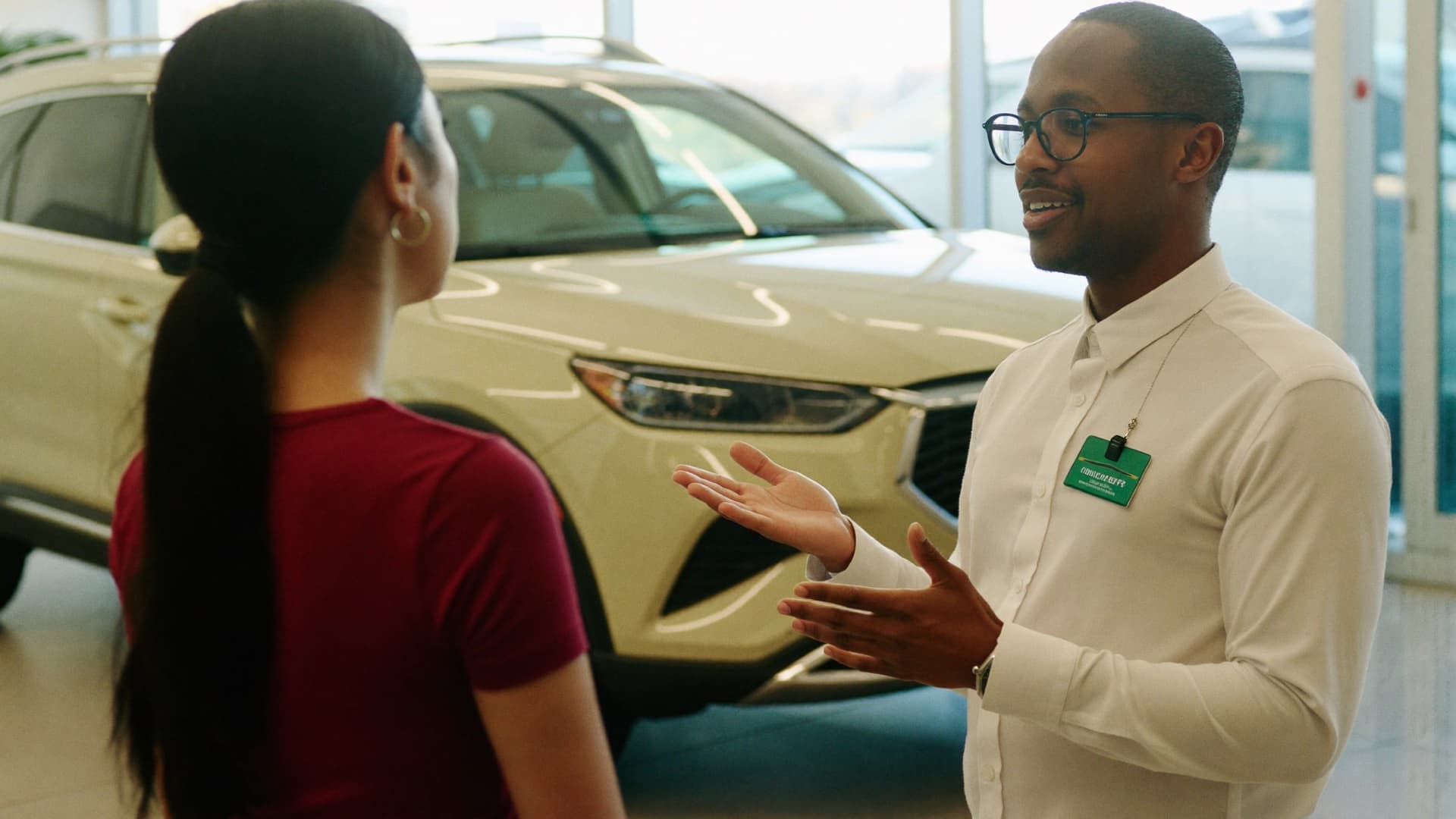
“I can get it cheaper elsewhere.” “I need to think about it.” “My wife hasn’t seen it yet.” Every car salesperson hears the same objections every week — and what they say in the next ten seconds decides whether the conversation keeps moving or dies on the spot.
We wanted to know what actually works. So we went through the automotive practice calls inside the CloserCoach app — real salespeople running full conversations against an AI customer — and read them line by line. We labeled 1,877 objection moments: what the customer said, what the rep said back, and what the customer did next. Did they warm up, ask a follow-up, agree to come in? Or did they repeat the objection, raise a new one, or check out?
These are practice calls, not showroom deals — the full methodology is at the bottom. But the patterns are strong, they repeat across hundreds of reps, and they match what the AI coach flags across 39,155 coaching notes. Here’s what the data says.
The three moves that keep a deal alive
For every reply, we tracked whether the conversation moved forward— the customer softened, engaged, or agreed to a next step — or stalled. Then we compared replies that contained each move against replies that didn’t.
Three moves separate the replies that worked: acknowledging the concern (75% moved forward vs 52% without — and only 35% of replies did it), asking a clarifying question (74% vs 56%), and answering with something concrete — options or proof, not promises. The deal-killers are just as clear: replies that argued or pressured moved forward 9% of the time. One in four replies contained at least one killer move — arguing, deflecting, rambling, or caving instantly — and those replies moved forward only 28% of the time.
The pattern data makes the order matter too:
Acknowledge, then clarify was the best two-step opener in the data: 88% of those conversations moved forward. And one surprise: jumping straight to the value pitch — “but look at everything you’re getting” — moved forward just 33% of the time, worse than average. Value lands after you’ve asked what they care about, not as the opener.
The move almost nobody makes
Keeping the conversation alive is only half the job. The other half is converting it into something — an appointment, a test drive, a scheduled callback. And there the data is brutal:
Asking is worth roughly seven times the agreement rate — and 79% of objection handles never ask. It’s also the single most-flagged skill across the AI coach’s 39,155 notes. A handled objection that doesn’t end in “Thursday at 5 or Saturday at 10?” is a conversation, not a sale.
The objections that actually hurt
Not every objection is equal. Here’s each one by how often the conversation moved forward after the rep’s reply — lower means harder — and how often the customer just repeated it.
“I can get it cheaper elsewhere” is the hardest objection in car sales. Only 38% of replies moved it forward, and 41% of the time the customer just said it again. “I need to think about it” is the most repeated. Here’s the playbook for the four that matter most — with real lines from the transcripts, and what the data says should’ve been said instead.
“I can get it cheaper elsewhere”
The hardest objection in car sales: 38% moved forward, and 41% of the time the customer just repeated it. A clarifying question first lifted it to 53%.
What customers say
“I’m definitely gonna get quotes from other dealers. Why would I pay more for the same car?”
“I’ve already done my research, so what can you actually show me that I haven’t seen online?”
They said
“We have just, um, different features… that make our vehicles have a little bit more price into it. Such as the sunroof.”
Should’ve said
“Good that you’ve done homework. Send me the exact listing and I’ll compare it line by line: trim, packages, miles, add-ons. Often the gap is equipment or year. If it’s truly identical, I’ll see what I can do.”
They said
“The way we treat our customers… integrity and family. We always put the customer first.”
Should’ve said
“Smart that you compared. What are you weighing it against? Then I’ll show you exactly what’s different, and if it’s not worth it, I’ll tell you.”
The talk track
Acknowledge (“Smart to shop it”) → ask for the exact listing and out-the-door number → compare apples to apples → show the one or two real differences → “If I can show you it’s the better deal, are you open to coming in to drive it Thursday at 5 or Saturday at 10?”
“I need to think about it”
The most repeated objection: customers raised it again 39% of the time, the highest of any. Half of reps acknowledged it — but 23 of 140 argued with it.
What customers say
“I think I just need a little time to think about it. It’s a big step for me.”
“Just email me the actual breakdown and let me look it over first. If it all checks out, I’ll pick a time to come in.”
They said
“But if you don’t mind me asking, what is there to think about? It has the safety features.”
Should’ve said
“Of course, I’ll send it. Just so I send the right info, is it more the monthly budget or whether it’s the right fit for the family?”
They said
“We really need to be there to walk you through the whole process…”
Should’ve said
“Of course, sending it now. I’ll call Thursday to answer questions, and if you want an exact quote then, we’ll set up the evaluation.”
The talk track
Acknowledge → “Totally fair. Usually it’s the payment, the car itself, or timing. Which one is it for you?” → address that one thing → “I’ll send it tonight. Let’s put 10 minutes on the calendar tomorrow at noon or 5 to go over it.”
“The payment is too high”
60% moved forward — when reps brought concrete options sized to the customer’s number instead of promises. A clarifying question lifted it from 56% to 70%.
What customers say
“I was hoping to keep it under 400 a month. That’s kinda my max.”
“600 a month is a bit more than I was hoping for. Does that include everything?”
They said
“I’m pretty new at this… I just wanna get you on a car you love, and then we can do numbers.”
Should’ve said
“Totally fair to want that first. What are you paying now, and roughly what do you owe? Let me run two quick scenarios.”
They said
“It’s gonna be the best vehicle you’re gonna have.”
Should’ve said
“If budget’s the priority, let’s compare the LT or a CPO LTZ side by side so you see the real payment difference.”
The talk track
Acknowledge → “What monthly feels comfortable, and is that with money down?” → options: term, down payment, trim, CPO → “If I can get you to $X on this one, would you want to drive it today or tomorrow?”
“No hidden fees. No games.”
The most common objection of all — 22% of every objection labeled. Specific transparency moved it; promises didn’t. Proof beats “trust me.”
What customers say
“I wanna know exactly what I’m paying for. No hidden fees. No runaround. Can you guarantee that?”
“That feels like you’re mixing discounts and trade numbers to make it look better. I want straight math.”
They said
“Absolutely not. We’re straightforward here… So could we get you signed up today?”
Should’ve said
“No hidden fees. Let’s go line by line: sale price, your trade, the optional protection package, the doc fee, and tax. Want me to remove the optional item and show the new number?”
They said
“You will be paying 700 dollars a month. The price is 54,000 after rebates…”
Should’ve said
“You’re right, let’s keep them separate. Truck price after rebates. Trade value. Taxes and fees. Amount financed at the rate. I’ll send it line by line.”
The talk track
Acknowledge (“You should ask that”) → put the line-by-line breakdown in writing → “Anything on there you want me to explain?” → advance.
One question changes everything
Across nearly every objection type, the same lever shows up: replies that asked a clarifying question before answering moved forward far more often than replies that answered straight away.
On “just looking,” a single curious question — “What’s got you looking, your current car or just curiosity?” — nearly doubled the moved-forward rate, from 48% to 92%. Even on the hardest objection, cheaper-elsewhere, asking first (“Were they quoting the same trim and miles?”) lifted it from 31% to 53%. The question is how you find the real objection behind the stated one.
What the top-graded calls do differently
Here’s the part most sales training gets backwards: the top-graded calls were not the smooth ones. Calls graded B or better faced more objections than the weak calls — 3.5 per call against 2.8. They didn’t avoid objections; they handled them, with handling quality graded 3.4 out of 5 against 2.4.
The gap that matters most is the last step: top calls secured a next step 62% of the time; weak calls, 32%. And when a rep asks for the close, the usual response is another objection — that happened 58% of the time in the data. That’s normal. The ask is where the real objection comes out. Reps who stop after the first “no” leave the deal right there.
The 4A Objection Loop
Put the findings together and you get a talk track that fits on a whiteboard. It’s built from what the moved-forward replies have in common — and almost nobody runs the whole thing: out of 1,495 labeled replies, only 5 did all four steps.
Running it on a live objection sounds like this:
Acknowledge.“That’s fair.” / “Smart to compare.” Validate it — don’t agree, don’t argue.
Ask.One clarifying question: “What number did you have in mind?” If concerns are stacked, isolate: “Other than the payment, anything else holding you back?”
Answer.The smallest thing that resolves it. Value concern → proof (warranty, CARFAX, a comparable listing). Money → options (term, down payment, trim, CPO). Trust → the line-by-line breakdown, in writing. Then check: “Does that solve it?”
Advance.Two specific options, day and time: “Thursday at 5 or Saturday at 10?” New objection? Loop — up to three times. Still no? Advance to the smallest next step: send the info with a scheduled callback time.
Never: argue, dismiss, fake urgency, change the subject, or monologue. Always end the exchange with a question that has a specific answer.
The AI coach sees the same three gaps
As a cross-check, we looked at what the app’s AI coach flags when it grades these calls — 39,155 coaching notes across 2,673 calls. The transcript reading and the coach point at the same habits:
Acknowledge. Ask. Advance. The three most-flagged gaps are the first, second, and fourth steps of the loop — which is exactly why it’s the thing to drill.
Methodology
The dataset is 3,267 automotive roleplays from 942 salespeople in the CloserCoach mobile app — practice conversations against an AI customer, four minutes or longer, graded, with a real transcript. 569 calls were read and labeled line by line against a fixed taxonomy (stages, objection types, rep moves, customer reactions), stratified across strong and weak calls for each objection type. That produced 1,877 labeled objection moments; the reaction stats use the 1,495 where both the customer’s line and the rep’s reply were captured. Coaching-note themes come from keyword matching across 39,155 scorecard notes on 2,673 calls.
Three honest caveats. These are practice calls, not real deals — no claim here is about showroom close rates or revenue. Labels come from model-assisted reading of transcripts, so treat the percentages as strong directional evidence rather than lab measurements. And everything is correlation: reps who did these things moved conversations forward more often; that is the claim, and the whole claim.
Practice these exact objections against an AI customer.